

2026
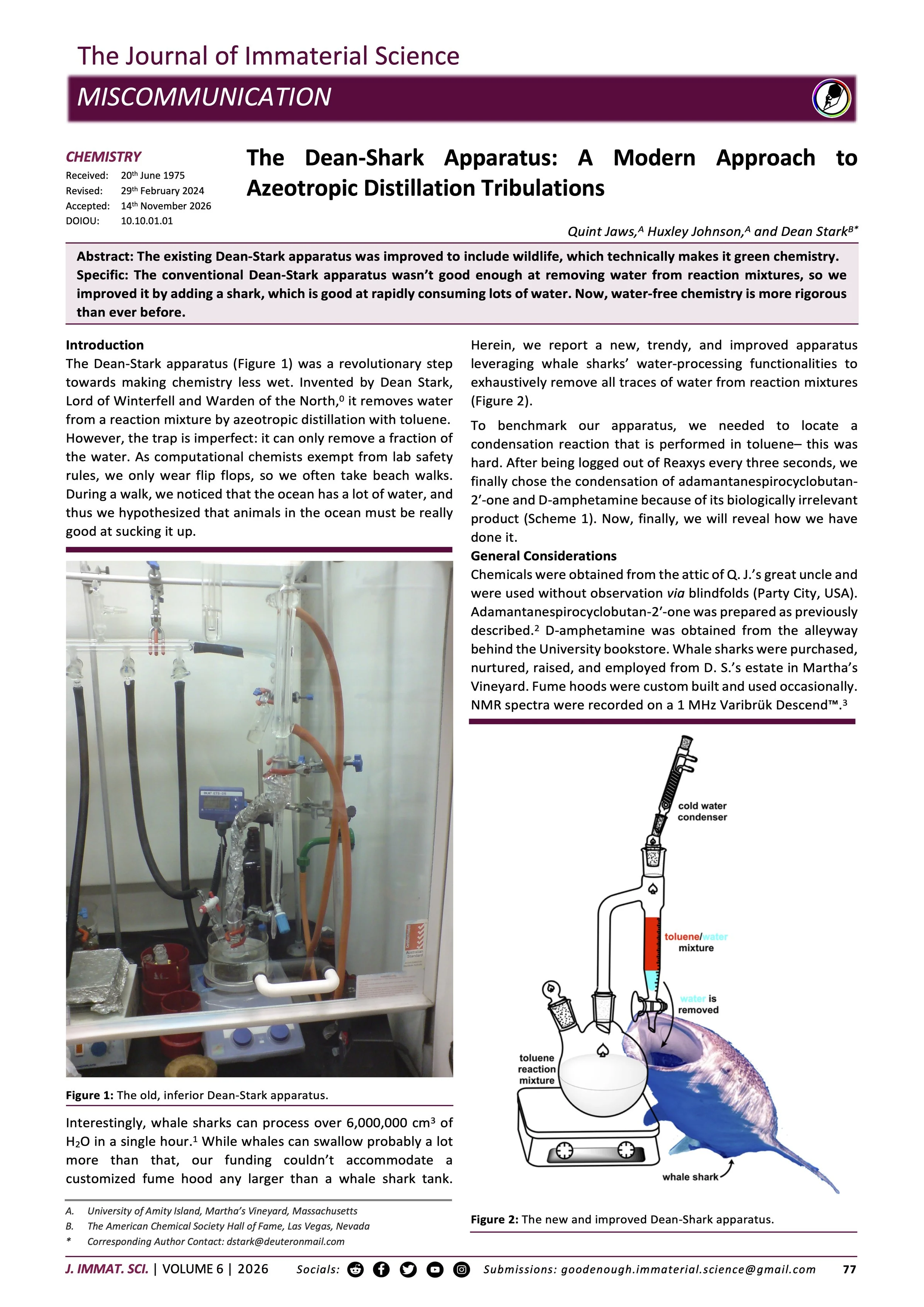
The Dean-Shark Apparatus: A Modern Approach to Azeotropic Distillation Tribulations
The conventional Dean-Stark apparatus wasn’t good enough at removing water from reaction mixtures, so we improved it by adding a shark, which is good at rapidly consuming lots of water. Now, water-free chemistry is more rigorous than ever before.

The Economics of Laziness: Why Rational Agents Never Finish the Milk
This paper studies why shared household goods are often left almost, but never completely, empty. A simple rule is considered: whoever finishes milk must replace it. When replacement is costly, rational agents have an incentive to consume as much as possible while leaving a strictly positive strategic residual drop. Rational laziness can explain why the milk carton is never technically empty, despite containing no useful amount of milk.

Ecto-Force Microscopy (EFM): A Process for Imaging Spectres
We have adapted the techniques of scanning probe microscopy to devise a process for measuring ectoplasmic forces. Our method uses a hotel californium (HCf) probe tip with a demonic soul (DS) point defect. The process described allows for the easy collection of characteristic spectra and non-optical optical measurements of wavelength. We benchmarked our technique by characterizing gadolinium cobalt (Gd0.2Co), which we found to be possessed by a red ghost with a density of malicious intent (DMI) of 0.218 ± 0.007 g/cm³.

Spun-Polaroid DFT Study of a Tungsten-Osmium Nanorod Exhibiting Exceptional Rigidity
We report a first-principles investigation of a novel W4Os₂ cluster in which a tungsten shaft, selected for its record holding melting point (3422 °C) and general firmness, is counterweighted by a pair of dense osmium nodes. Calculations at the PBE/def2-SVP level predict a large aspect ratio, and a great personality.

How Much Does An Electron Cost?
It turns out that electrons are a bit like property: their value is tied to their location. A modest three-bedroom house in Manhattan could be valued at over $4.5 million, while an identical house in Frogballs Arkansas costs $8.50, asbestos included. This paper is a quest to find the world’s most valuable electrons. We began with intentions of making snide remarks about blueberries, but when we crunched the numbers, they told us a completely different story. Herein, we discuss our findings and present a grand unified electron pricing structure.

Adilettes-Assisted Catalysis: Investigating Gopnik Squatting and Sunflower Seed-Induced Reactivity
Metal catalysts are in everything: cars, factories, and even my wife. However, heavy metal catalysts are not good for the environment. In this paper, we report a novel catalytic approach to a more environmentally-friendly synthesis of gopnikadine. This was accomplished via Adilettes-assisted squatting (which decreased the activation energy of a crucial step by 193.7 kJ/mol) and optimised sunflower seed consumption.

Your 3D Printer is Pooping, and Manufacturers are Racing to Constipate It
Multi-colour 3D printers routinely excrete small, warm blobs of purged plastic known as “poop”. We propose the Bristol Poop Scale, warn readers that today’s poop is tomorrow’s microplastic, and derive the Law of Conservation of Poop, which proves that manufacturers can make printers constipated but never poop-free.

Evaluating The Statistical Feasibility Of Spontaneous Anthropomorphic Flight: Density Compression Versus Localized Atmospheric Compression
The stochastic feasibility of human (Homo sapiens) aviation is investigated using two competing theories: density compression of human matter to less than 1.225 kg/m3, and localized atmospheric (Poisson) compression by a factor of 872. Mathematical models demonstrate that human density reductions (P = 1.36 × 10-1263) are slightly more feasible than atmospheric compressions (P = 10-10^-28), with both techniques pending further empirical validation.

Fitting A Person Into An NMR Spectrometer
This article examines the circumstances under which a human could fit inside an NMR spectrometer.

The Pizza Tray Is Too Small and Nobody Planned for This
The pizza is too large for the tray. We study how much of a circular pizza of radius R can be retained as one connected piece inside a circular tray of radius r < R using n straight cuts. For a tray-arc span S, we derive an exact area formula and reduce the whole crisis to a one-variable numerical maximization. As n approaches infinity, the retained area approaches the full tray area, although the required knife work approaches a cry for help.

Revolutionary Old Technology Allows Laymen to Probe Molecular Structure
Untucked homies are the main reason AI slop has besplattered our feeds in recent years, as sleep deprivation degrades one’s capacity to think creatively. This is troubling in and of itself, but an even more distressing issue is the sight of one’s homie’s cold feet sticking out under the duvet, unloved and uncuddled. Recent studies have discussed this issue without providing concrete solutions. Herein, we report a novel way to tuck in your homies.

Isocyclotoe-Brosylate: A Chemical Reason to Kiss Your Homies Goodnight
Untucked homies are the main reason AI slop has besplattered our feeds in recent years, as sleep deprivation degrades one’s capacity to think creatively. This is troubling in and of itself, but an even more distressing issue is the sight of one’s homie’s cold feet sticking out under the duvet, unloved and uncuddled. Recent studies have discussed this issue without providing concrete solutions. Herein, we report a novel way to tuck in your homies.

The Impact of Psychotherapy on the Stability of Perovskite Solar Cells
This paper examines psychotherapy or “talk therapy” as a method to stabilise tin(II) in the crystal lattice of lead-tin perovskites, a piezoelectric material used in some solar panels.

A Revolution in Benchtop NMR: The 1 MHz Spectrometer
This article details a breakthrough in upper-middle-field nuclear magnetic resonance (NMR) spectroscopy: the development of a 1 MHz spectrometer.

A Critical Update to Laboratory Hazard Signage
Following a serious laboratory accident, all Australian university facilities must now display new warning signage.

The Nose Schlenk
For those of you who miss pipetting by mouth, we offer you the opportunity to Schlenk by nose.

Five Years of Progress in the Chemistry of the Futyl Group
This comprehensive review summarises all the advances in futyl chemistry since 2021. Nobody has made any advances in the chemistry of the futyl group since 2021. In order to justify the existence of this paper, we have used computational chemistry to analyse the energies of all the reactions in the last review

Bacteriophages are Probably From Mars
Bacteriophages are viruses that target and kill bacteria. They resemble alien spaceships like the ones from War of the Worlds by H.G. Wells. With distrust of science on the rise, there’s never been a better time to advocate for the existence of aliens. They are among us.

Reinventing Disseminated Intravascular Coagulation Care Using Positively Fresh Plasma: the Extracorporeal Membraneless Tokamak (ECMTo) Trial
This paper discloses a novel treatment for people with blood clotting disorders: connect the patient to a fusion reactor and infuse ionic plasma directly into their circulatory system.

Principia Sociodynamica: The Three Laws of Conservation of Blame
Throwing out the usual subjective behavioural models, we establish that blame is the most abundant resource in the universe. It is neither created nor destroyed. Instead, it gets passed around through rotational displacement.